
Rent Your Voice for AI Training: How It Works, Where to Apply, and What to Avoid
Updated: December 24 (Europe/Madrid)
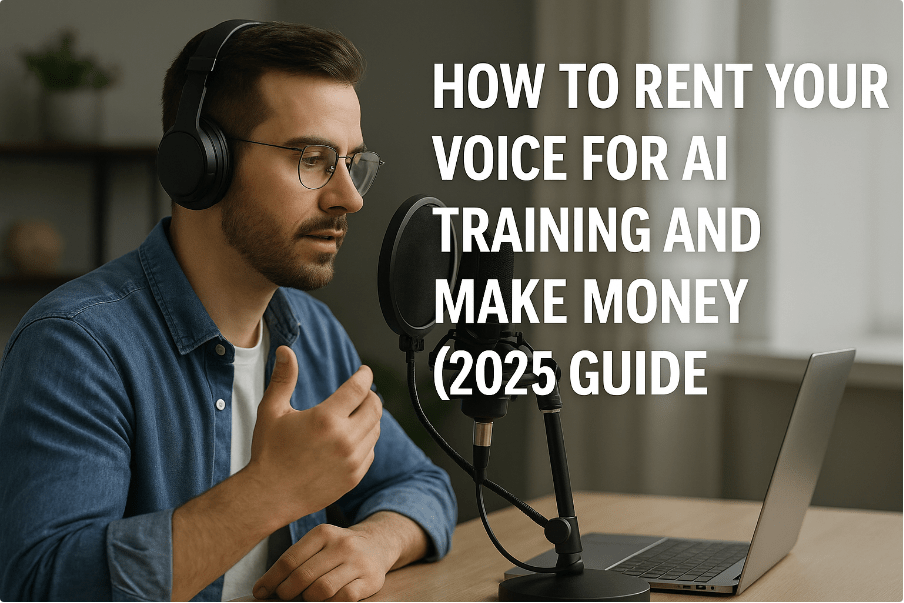
Want to rent your voice for AI training in a legit way? In 2026, there are real opportunities, but also real risks: bad contracts, perpetual rights, and scams that use voice cloning to cause harm. This guide shows a practical system: choose the right path (data collection vs licensing), apply safely, record clean audio, and protect your rights. No income promises.
Start here (hub): How to Earn Money Online (US)
Related EN guides: AI Side Hustles for Beginners ·
AI Tools to Make Money
What «renting your voice» actually means
Most offers fall into one of these:
A) Audio data collection
You record scripted or semi-scripted audio so models learn accents, pronunciation, and speech patterns (ASR/TTS improvement).
Typical: one-time tasks, paid per task/hour after QA approval.
B) Voice licensing / voice library
Your voice is used to create a voice model or is offered in a library under a license. Payment can be usage-based or contract-based.
Key: rights and usage limits matter more than the headline payout.
Important: if the agreement allows broad reuse (commercial content, sublicensing, unlimited term), you are not just «training a model» anymore. You are giving a company the ability to deploy a version of your voice widely.
Two legit paths: data collection vs voice licensing
If you are a beginner
- Start with audio data collection (lower rights risk, simpler scope).
- Build a clean recording workflow and hit QA standards.
- Track effective hourly rate after re-takes.
If you are voice talent
- Consider voice licensing only with strong consent, limits, and compensation terms.
- Ask for usage scope: where, how long, what categories, and revocation options.
- Never rush. Contracts define your future leverage.
Where to find legit opportunities
The safest filter is simple: use well-known platforms with clear identity, written terms, and a quality review process. Avoid random DMs.
Audio data collection (projects)
- TransPerfect DataForce projects
- DataForce overview (voice data collection)
- Defined.ai (data collection services)
What to expect: scripted prompts, device requirements, QA checks, payment after approval.
Voice licensing / ethical voice marketplaces
Focus: licenses, consent, usage limits, transparency.
Voice library payout models
Reality check: «payouts» can exist, but do not assume passive income or stable demand.
Contract checklist (control your voice)
If you sign one thing from this article, sign this: never accept vague, unlimited rights. You want scope, limits, and auditability.
Must-define clauses
- Purpose: training only vs training + commercial generation
- Term: start/end dates (avoid «in perpetuity»)
- Territory: where it can be used
- Categories: ads, games, adult, politics (restrict what you do not want)
- Sublicensing: can they resell your voice to third parties?
Control + transparency
- Consent: written, explicit, revocable where possible
- Usage reporting: what was generated and where used
- Security: storage and access controls
- Removal: what happens if you terminate?
Benchmark: industry agreements increasingly emphasize consent and disclosure for AI digital replicas.
Payment logic
- Flat fee (simple, but risk if rights are broad)
- Usage-based (needs reliable tracking + reporting)
- Hybrid (minimum fee + usage kicker)
If you cannot audit usage, «usage-based» can become meaningless.
Safety note: voice cloning can be used for scams. Read consumer guidance on harmful voice cloning and protect your voice samples. FTC voice cloning alert
Recording setup + quality checklist
Minimum setup
- Quiet room (soft surfaces, minimal echo)
- Consistent mic distance (hand span rule)
- No fans, AC noise, or keyboard clicks
- Same device settings for the whole project
QA pass checklist
- No clipping or distortion
- Consistent volume across takes
- Clean starts/ends (no breath spikes)
- Read exactly as instructed (pronunciation, pacing)
Beginner habit
Record a 20-second test, listen on headphones, fix noise, then start the real batch. This saves re-takes.
Payment models + sanity checks
Your real metric is not the advertised payout. It is your effective hourly rate after setup time, re-takes, and QA rejects.
For data collection gigs
- Track total minutes recorded vs minutes accepted
- Include re-takes as «cost»
- Prefer projects with clear QA specs
For voice licensing
- Match pay to rights scope (narrow scope = lower risk)
- Ask for limits on use cases you do not want
- Require usage reporting if payment depends on use
Red flag pricing
If the deal asks for broad, unlimited rights for a small one-time fee, you are selling long-term control for short-term cash. Slow down.
KPIs (track this like a project)
Acquisition KPIs
- Applications/week: 10 to 20 targeted
- Acceptance rate: accepted projects per applications
- Time to first paid approval: days from start to payout
Quality KPIs
- QA pass rate: accepted minutes / submitted minutes
- Re-take load: re-take minutes per accepted hour
- Consistency: same room, same settings, fewer rejects
Money KPI (no hype)
Effective hourly rate = (total payout) / (total hours including setup + re-takes). If it is low, improve audio quality, pick better projects, or stop.
48-hour action plan
Hours 1-3: choose your path
- Beginner = audio data collection
- Voice talent = licensing only with clear limits
- Write your «no-go» list (politics, adult, ads, etc.)
Hours 3-12: build recording reliability
- Set up a quiet space and record 3 test clips
- Create a checklist for noise and consistency
- Save one clean «reference» clip as your baseline
Hours 12-48: apply safely
- Apply to 5-10 legit projects/platforms
- Do not accept rushed contracts
- Track every application and follow up once
30-day plan (weekly sprints)
Week 1: quality and one payout
Aim to complete one small project end-to-end with a high QA pass rate.
Week 2: repeat and optimize
Improve setup, reduce re-takes, and push effective hourly rate up.
Week 3: upgrade opportunities
Apply to better-scoped projects. If considering licensing, negotiate scope and reporting.
Week 4: decide your lane
If data collection is low ROI, stop. If it works, keep the SOP and scale carefully. Licensing is optional and higher-risk.
Reminder: voice cloning can be weaponized. If an offer arrives via random text/DM and pressures you, treat it as suspicious and verify independently.
FAQ
Is renting my voice for AI training safe?
It can be, if the project is legitimate and the contract limits usage. Data collection projects are usually lower risk than broad voice licensing deals. Always verify the platform, read terms, and avoid rushed agreements.
What should I avoid in a voice licensing contract?
Avoid vague scope, unlimited term («in perpetuity»), unrestricted categories (ads, politics, adult), and sublicensing without reporting. Ask for written consent terms, usage limits, and transparency.
Do I need professional equipment?
Not always. Many projects accept smartphone recordings if the room is quiet and the audio is clean. Quality and consistency matter more than expensive gear for entry-level tasks.
How do I know if a voice job offer is a scam?
Red flags: random text offers, upfront fees, pressure to move to WhatsApp/Telegram, or requests for sensitive info early. Verify the company domain and apply through official pages.
INFORMACIÓN BÁSICA SOBRE PROTECCIÓN DE DATOS
Información adicional: Puedes encontrar información adicional sobre la protección de datos en nuestra política de privacidad